

Healthcare and medical billingFilm · 2 min
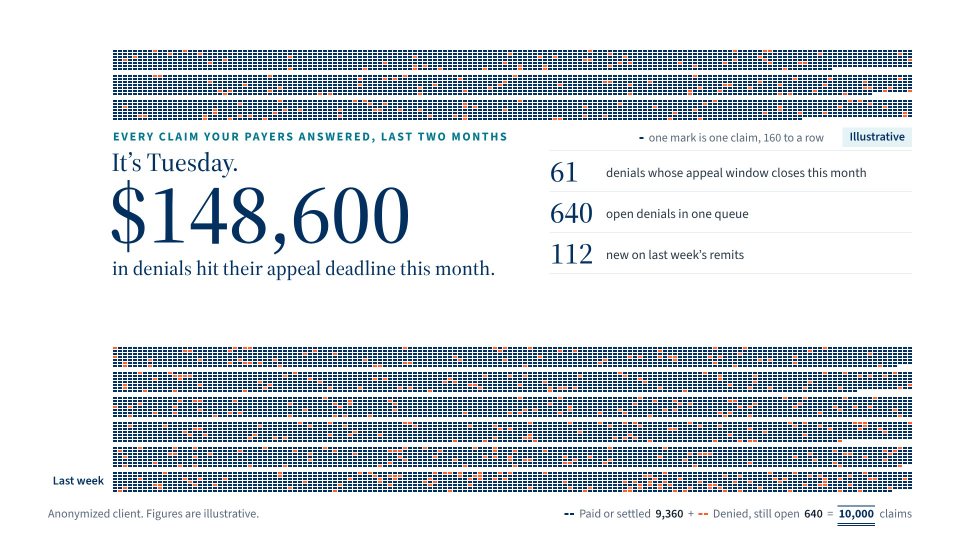
Denials come in faster than we can work them
A specialty physician group on ModMed and Waystar, working every denial oldest first from one queue.
Revenue cycle and billingAt an orthopedic group under one MSO, prior auths started days after the order was signed and lived across Availity, the payers’ own portals and a fax line, so a scan could be done before its auth took effect. We redesigned the work first, so every auth starts at the order and runs from one central queue, then built an agent that assembles each packet for the coordinator to submit, beside the systems the team already runs.
Chapters
At a glance
As redesigned
The auth starts the moment the order is signed, and nothing that needs one is scheduled without an auth status.
One central queue for the whole MSO, in place of a tracker in every office.
One owner, the patient access manager, keeps the rules library (which payer needs an auth for which code) and a packet checklist for each service line.
As built
Product names and logos are trademarks of their respective owners.
The measure
Median days from order to auth decision, counted the same way before and after, with the payer’s own days left in. And the hours a week each coordinator spends rebuilding packets and on hold for status.
40 prior auths per physician per week, taking 13 hours of physician and staff time.
More work
A specialty physician group on ModMed and Waystar, working every denial oldest first from one queue.
Revenue cycle and billingA sterile fill-finish CDMO on MasterControl, with batches waiting on the chase after the sterility test.
Integration and automationA molder and machine shop on MachineMetrics, where every stop was recorded and maintenance took the blame.
Integration and automationNext step
If you run a company like this one, back one or lend to one, a principal replies within one business day and holds a first call.